The focus of my scholarly and professional work is on the experience, relationship, and interaction between people and the information they are creating, using, and seeking. This exploration has spanned a variety of disciplines, theories, and methods over the last several years, ranging from Art-based research (ABR) to user engagement. In addition to my academic research work, I also work as a freelance researcher, most recently for Writing Short is Hard. Please see Curriculum Vitae for a more detailed description of my work. Below is a selection of some workshops and presentations that show the breadth of topics and approaches.
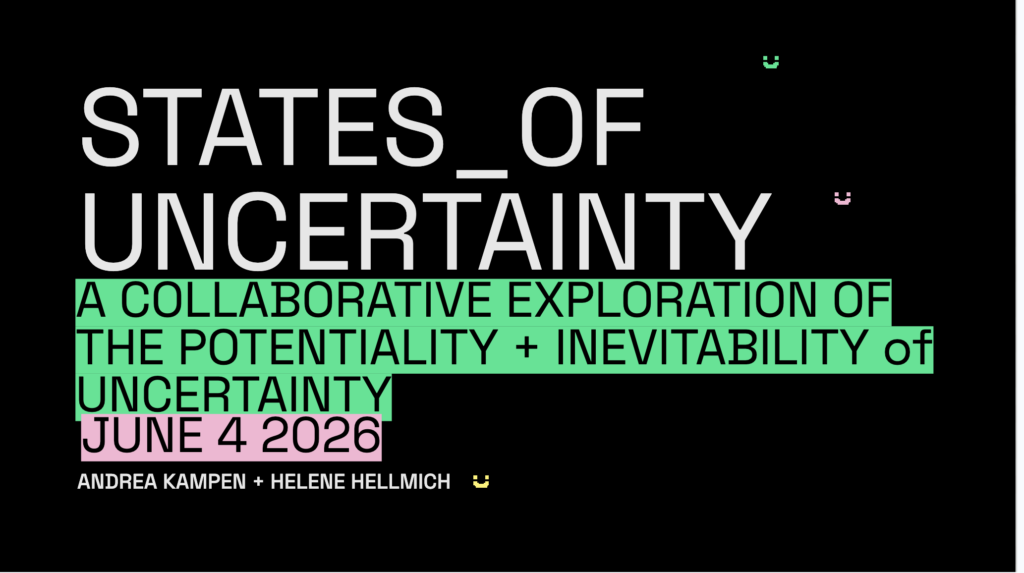
States of Uncertainty: A collaborative exploration of the potentiality + inevitability of uncertainty
This upcoming workshop is happening at ISIC and was developed in collaboration with Helene Hellmich. Uncertainty is often considered something to be reduced or mitigated. In this workshop, we propose thinking with uncertainty differently. By engaging with the generative possibility and inevitability of uncertainty through the examination of participants’ affective and sensory experiences, we want to explore what uncertainty means and develop capacities to explore the potentiality of uncertainty in Library and Information Studies (LIS) research. As part of this workshop, participants will be encouraged to explore a series of interventions and provocations through arts-based approaches and critical dialogue. Arts-based approaches value the uncertainty and playfulness of the creative process (Barone & Eisner, 2012; Leavy, 2020). In the proposed workshop, participants will engage in a series of activities, including self-reflection, writing, drawing, movement, and material making. In this workshop, we propose expanding the current understanding of uncertainty in LIS to consider its potential virtues. By leaning into the potentialities of uncertainty, such as its generative possibility and inevitability, we hope to support its use in future thinking, creative processes, and decision-making.
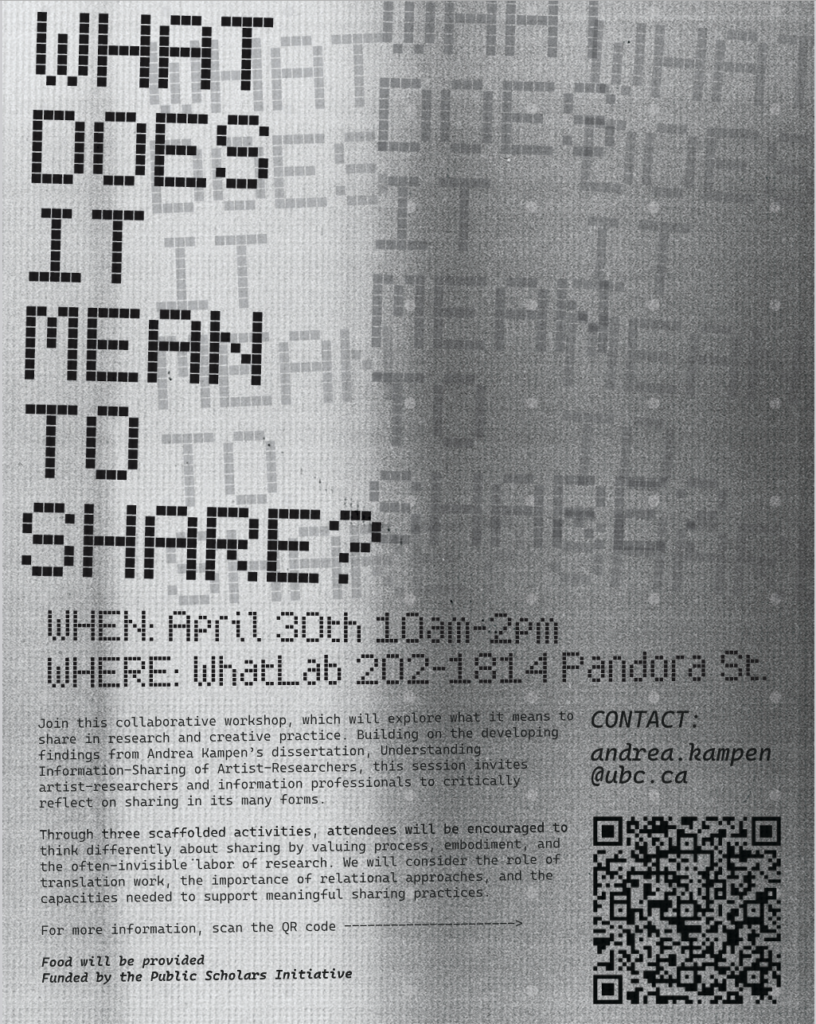
What Does it Mean to Share Workshop
What does it mean to share?
This collaborative workshop, funded by the Public Scholars Initiative, explored what it means to share in research and creative practice. Building on the developing findings from my dissertation, Understanding Information-Sharing of Artist-Researchers, this session invited artist-researchers and information professionals to critically reflect on sharing in its many forms.
Through three scaffolded activities, attendees were encouraged to think differently about sharing by valuing process, embodiment, and the often-invisible labor of research. We considered the role of translation work, the importance of relational approaches, and the capacities needed to support meaningful sharing practices.
A zine publication is under development.
FriendOf + NeighbourOf: Exploring relational capacities
This poster, presented at ARLIS and developed in collaboration with Hillary Webb, represents a work-in-progress research project investigating the threads connecting topics of ‘friendship as method’ (Tillmann-Healy, 2003), the ‘law of the good neighbour’ (Warburg, n.d.), digital representations of relationships, and linked open data. Drawing on the example of the Friend of a Friend (FOAF) ontology, the poster explores the capacities that friends and neighbours could contribute to the resistance of a variety of institutional expectations, including the commodification of relationships, capitalism, and academia’s “publish or perish” culture.
Drawing on the capacities suggested by friendship (e.g., trust) and neighbours (e.g., generative interaction), we consider their applications to linked open data and metadata, and cataloguing processes. How can/could these capacities contribute to resistance in institutions and other infrastructures of neoliberalism?
As a case study example, we use the largely surpassed Friend of a Friend (FOAF) ontology, developed in 2000 by housemates Libby Miller and Dan Brickley, a machine-readable way to describe persons, their activities, and their relations to other people and objects. An intriguing and engaging solution to create a web of digital relationships between people and objects, we wonder what held back its success. Is building a semantic web still possible? Or is it a moot point with the rise of GenAI. Alternatively, will the solution include the use of AI tools?
The poster will explore these ideas and invite the people in the room to be co-conspirators in exploring the capacities of friends and neighbours and to consider their potentiality to inform and resist.
Time and space and shitty lighting: The use of polaroid photographs in qualitative research
This presentation offered methodological reflection on the use of Polaroid photography within interview-based study research. In my dissertation study, titled Understanding information-sharing of artist-researchers, I drew on semi-structured interviews, and collaboratively selected and took three Polaroid photographs in the participant’s studio. These photographs served multiple functions: they helped counter recall bias by capturing moments of information-sharing in real time, and they documented the physical environments in which artistic research takes place. The presentation will examine why I selected Polaroid photography to foreground temporality and materiality, as well as intimacy and proximity. These types of photographic process invited both immediacy and patience, allowing the participant and researcher to witness the photograph as it developed. Unlike digital photography, which is instantly reproducible and embedded in personal devices, the Polaroid existed as a shared, physical object created together within the studio space. The limited frame of the Polaroid introduced intimacy and proximity, while also emphasizing exclusion. Many photographs contained visual imperfections, such as blown-out exposures or warped edges caused by uneven chemical development. The expense of Polaroid film further shaped the process, making selectivity explicit. Decisions about what to photograph were negotiated, with participants often suggesting or arranging subjects themselves. The images were later labeled, digitized, and analyzed using visual content analysis (Rose, 2016), examining themes, patterns, and their broader social and cultural contexts.
Does Every Gap Need a Bridge?
Pictorial metaphors have been used in Information Studies (Hartel & Salvolainen, 2016) to respond to the challenge of conceptually considering and empirically examining information phenomena. Metaphors offer “methodological and heuristic guidance” to ask questions regarding “how people interpret information to make sense of it” (Savolainen, 2006, p. 1116). Luminary information scholar Brenda Dervin’s (1999; Dervin & Frenette, 2003) graphical representation of sense-making uses the metaphor of a gap-bridging journey. The visual depicts a figure standing at the precipice of a gap, with collection of flags erect on the opposide side. The construction of the “informational” bridge that connects the two sides—labelled as “situation” to “outcomes”—is built by identifying and combining ideas, cognitions, thoughts, etc. Crossing the gap is made possible by sense-making/sense-unmaking. The proposed presentation describes my attempt to traverse the gap-bridging pictorial metaphor through the creation of a visual artifact using the eco media of small file film (SFF). SFF uses an average of about a megabyte per minute, which offers a sustainable, low carbon footprint alternative to streaming media. By crunching and reducing the visuals into these smaller units the image can also be altered in unexpected and uncertain ways. This abstraction of the image offers an opportunity to explore issues of ambiguity present within sense-making, as well as offer a physical manifestation of reduction. This work-in-progress SFF is a naïve art-practice (i.e., indicating a lack of formal education) and invites questions of possibility and constriction for the creation and use of pictorial metaphors.
Information Art: Engaging with conceptual art and arts-
based research in Information Studies Workshop
This workshop, presented at Conceptions of Library and Information Science and in collaboration with Dr. Rebecca Noone, explored the synergies of Information Studies (IS) and an
understudied form of conceptual art—Information Art. We asked: What can thinking with Information Art offer us in our capacity to develop and explore concepts in IS?
The purpose of this alternative-event was to foreground arts-based research in Information Studies that is informed and inspired by what may seem like an impenetrable world of conceptual art. As part of the workshop, we will discussed how conceptual art resonates with traditional research, celebrating process and ideation, connection and relationship, and exploratory theory-building. The goal of the workshop was to activate alternative forms of conception in library and information studies that participants can apply to their research and teaching practices. The objectives were to 1) introduce Information Art and its conceptual relevance to IS and arts-based practice; 2) test out Information Art as a form of arts-based research; and 3) cultivate a collaborative community of IS scholars and practitioners interested in Information Art.
Conducting Creative Research
In support of learning about research-creation, I am participating in a research team from Emily Carr University of Art and Design (ECUAD). We are developing an article regarding a speaker series organized by ECUAD and Ontario College of Art and Design (OCAD) titled Conducting Creative Research.
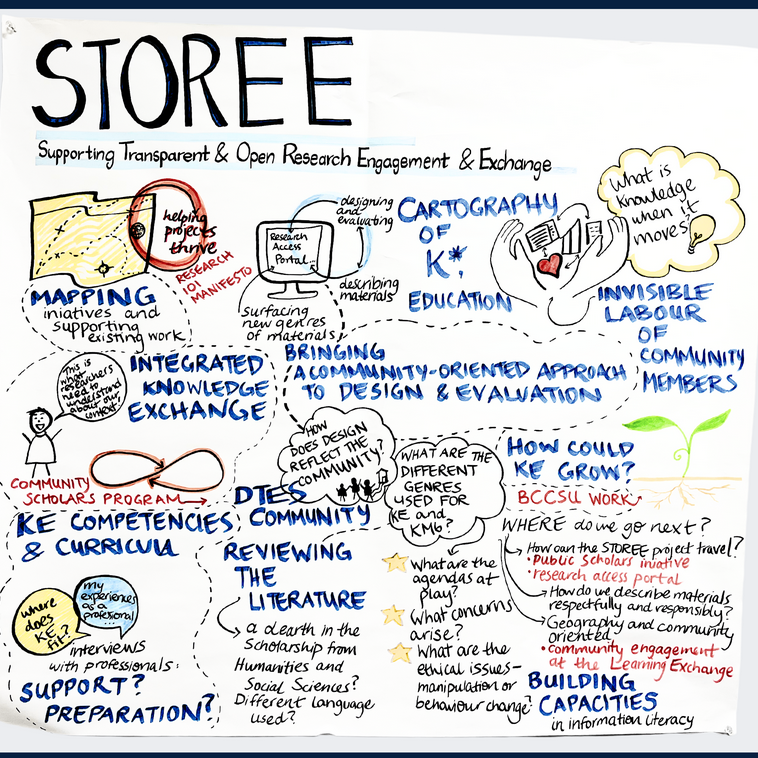
Supporting Transparent & Open Research Engagement & Exchange
This initiative, Supporting Transparent & Open Research Engagement & Exchange (STOREE), is a collaboration between various institutions to support the communication of research. As part of my work for the STOREE project, I conducted a literature review of arts-based research in library and information studies. Together with my colleague Heather De Forest we analyzed and synthesized findings in the form of a journal article.

Effects of Domain Knowledge Interest and Difficulty on Searching, Learning, and Engaging with Digital Libraries
For this project, I collected data through screen capture using Morae and Qualtrics to examine the relationship of users’ domain knowledge and perceptions of search difficulty while using a digital library. I planned and modified research techniques, procedures, tests, and equipment, and monitored software management following pilot testing. Additionally, I scheduled, organized, and reported on the status of research activities.
PhoneMe Poetry app
I supported the development of onboarding material for a place-based poetry mobile application called PhoneMe (Principle Investigator Kedrick James with collaborators Amelia Cole and Andrea Hoff). I contributed by researching, designing, and presenting UX principles in a Digital Humanities context.
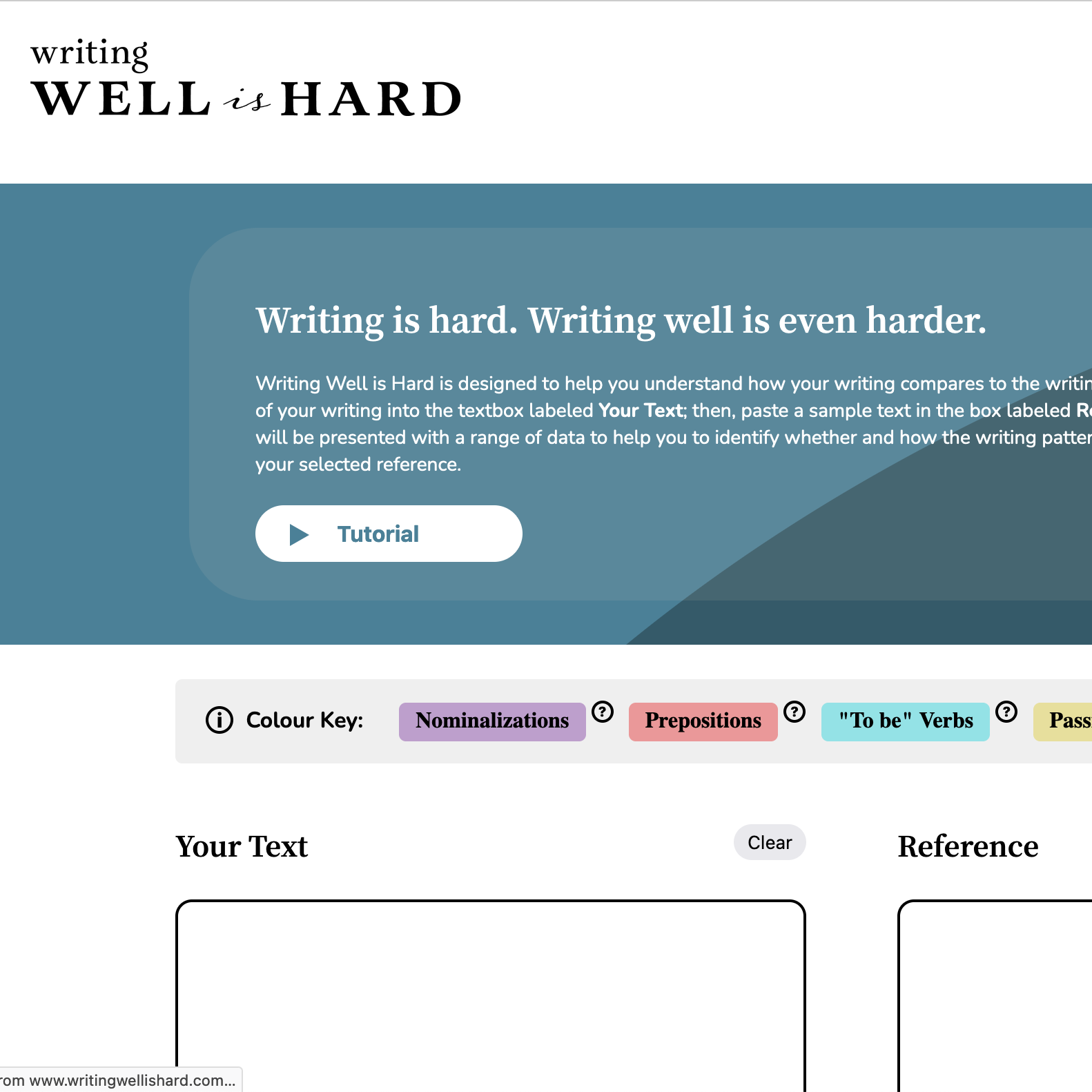
Writing Well is Hard
As part of my work for Dr. Letitia Henville, I developed and facilitated focus groups and usability testing for a text analysis tool (Writing Well is Hard). Following the focus groups I analyzed and reported findings.